


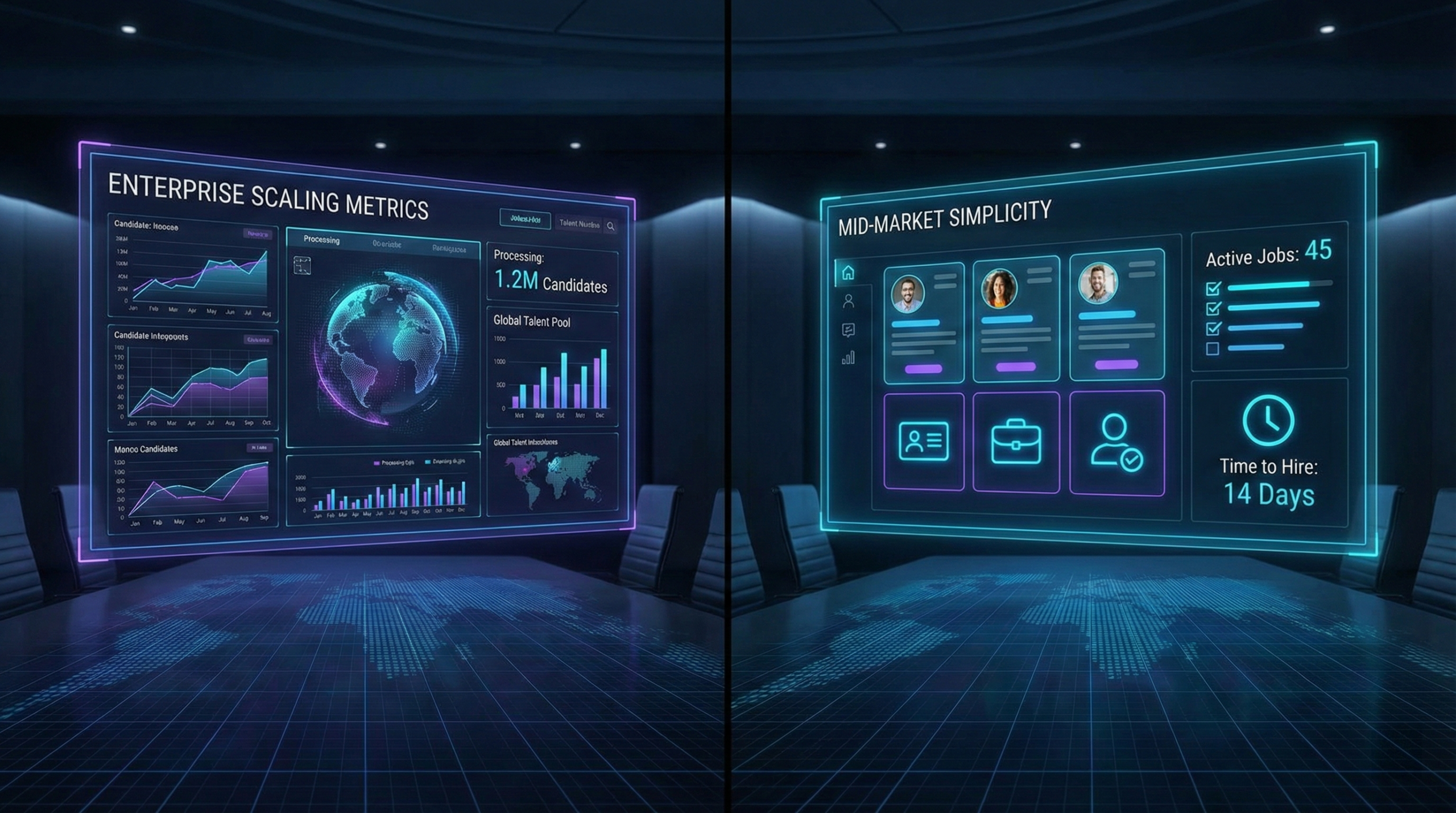
The ATS market is no longer monolithic; platform specialization has emerged to serve distinct organizational segments with varying hiring complexity, compliance requirements, and scaling challenges. When comparing enterprise-oriented ATS solutions with platforms designed for mid-market firms, organizations must consider differences in configurability, integration depth, analytics maturity, global compliance, and support structures. The goal is not to determine which segment is objectively superior, but to align platform capabilities with operational realities and resource constraints.
Enterprise ATS platforms typically prioritize scalability, multi-region compliance, robust workflow customization, and deep integration with HRIS/HCM ecosystems. These systems often support distributed hiring teams, multiple hiring models (hourly vs corporate vs campus), and global workforces. Enterprises require configurable approval chains, granular role permissions, multi-language interfaces, and audit trails that meet stringent regulatory standards across multiple jurisdictions. They also place higher emphasis on vendor roadmap transparency, SLAs, implementation support, and long-term data governance.
Mid-market ATS solutions generally focus on usability, faster deployment, and cost efficiency. These platforms support organizations that have outgrown manual hiring processes but do not yet require enterprise-level orchestration or global compliance frameworks. Mid-market buyers often prioritize intuitive workflow design, straightforward integrations, and reporting dashboards that require minimal configuration. Because these companies frequently operate with smaller talent acquisition teams, automation and communication features deliver significant productivity gains without the overhead of complex administrative management.
Analytics and reporting maturity is another differentiating factor. Enterprise-grade solutions may offer predictive analytics, talent forecasting, sourcing channel optimization, and workforce analytics integrations. Mid-market tools typically provide funnel metrics, time-to-hire dashboards, and performance reporting suitable for operational insight rather than strategic modeling.
Pricing and total cost of ownership vary accordingly. Enterprise ATS implementations may involve multi-year contracts, dedicated implementation teams, integration fees, and change management services. Mid-market platforms aim for lower deployment friction, offering tiered subscription models and template-based configurations that reduce onboarding time.
Ultimately, choosing between enterprise and mid-market ATS solutions is a question of organizational complexity, hiring volume, compliance footprint, and technical maturity. Companies that misalign platform selection—by adopting an enterprise-grade ATS without sufficient operational need, or by selecting a mid-market ATS that cannot accommodate growth—risk encountering workflow bottlenecks or costly reimplementations.
