


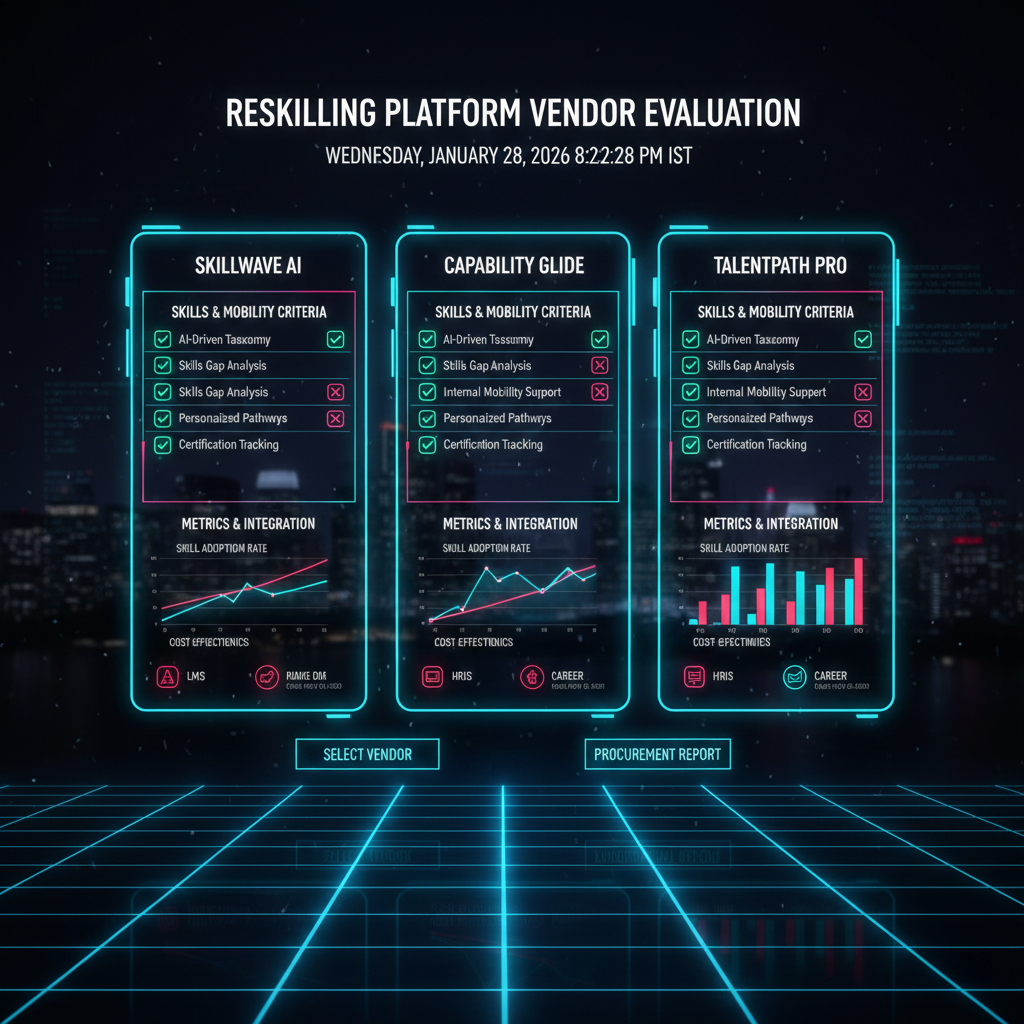
Selecting upskilling and reskilling solutions requires evaluating platforms across content alignment, skills intelligence, assessment capabilities, certification, mobility integration, and analytics. Because upskilling and reskilling intersect with talent strategy, workforce planning, and learning, procurement must be multi-stakeholder.
Content alignment determines whether learning resources map to skills required for transformation initiatives. Generic content libraries lack performance relevance, whereas role-mapped content accelerates proficiency.
Skills intelligence capabilities identify workforce gaps and infer skill progression. Systems with AI-driven skill inference, ontology matching, and proficiency modeling produce higher planning accuracy.
Assessment capabilities validate progress. Solutions may include knowledge tests, performance simulations, practical assignments, and certification exams.
Certification adds credibility and signals proficiency to managers and talent systems. Certifications can be internal, vendor-specific, or industry-standard.
Mobility integration connects learning to opportunity through internal marketplaces, career frameworks, or project assignment systems. Without mobility alignment, reskilling may fail to produce redeployment outcomes.
Analytics provide visibility into adoption, proficiency gains, completion, and ROI metrics. Advanced solutions model workforce readiness and transformation timelines.
By applying structured criteria, enterprises can select solutions that drive measurable capability outcomes and support strategic transformation.
