


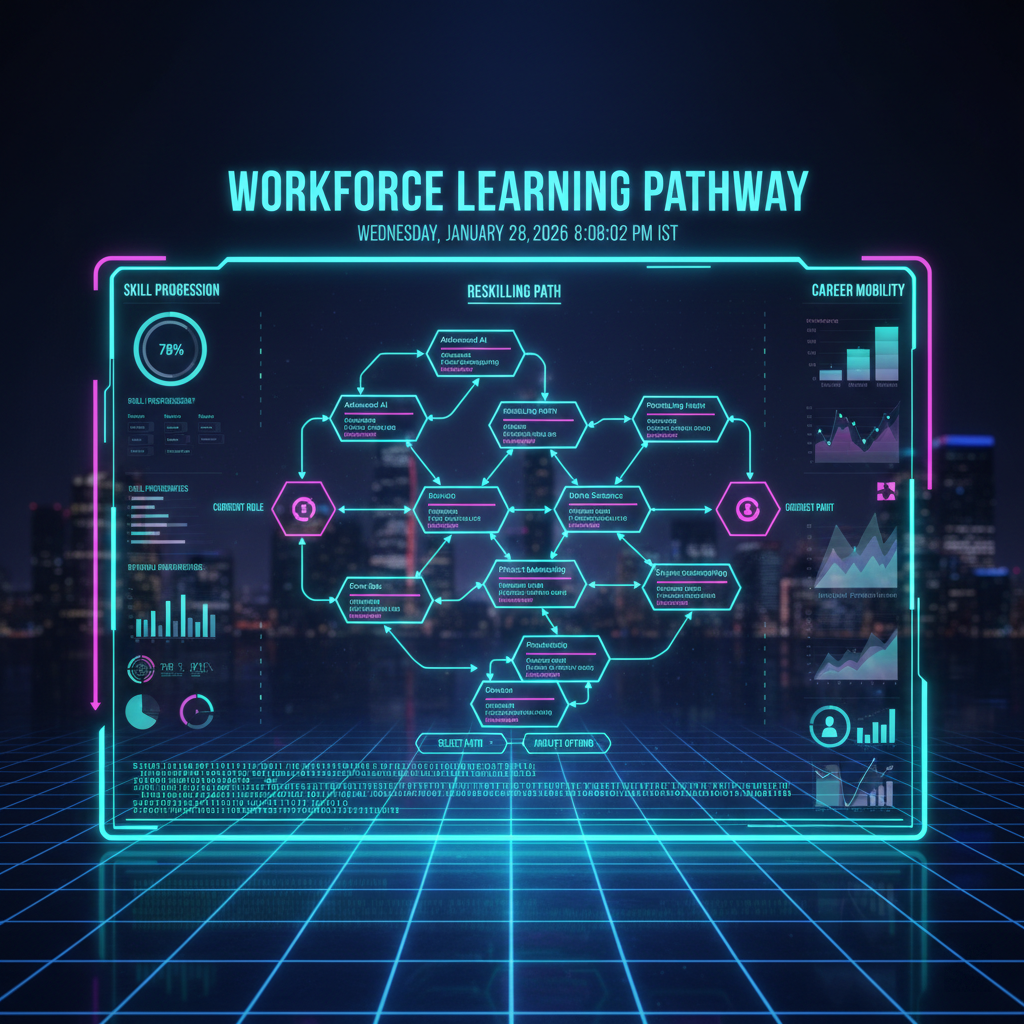
Effective upskilling and reskilling programs require several foundational components: skills gap analysis, role-based skill mapping, personalized learning pathways, assessment and certification, learning reinforcement, and mobility alignment.
Skills gap analysis identifies capability shortages by comparing existing workforce skill profiles against target skills required for future roles, projects, or transformation initiatives. This allows organizations to prioritize investment in specific competencies with measurable outcomes.
Role-based skill mapping defines the skill requirements for current and future roles. This ensures that learning pathways are relevant to operational needs and not generic training initiatives that lack performance alignment.
Personalized learning pathways guide employees through structured training sequences. Pathways may include foundational modules, applied learning, stretch assignments, microlearning, mentorship, and certification prep. Personalization improves learner engagement and accelerates mastery.
Assessment and certification validate knowledge acquisition and proficiency. Certification—whether internal or industry-recognized—strengthens credibility and supports performance validation.
Learning reinforcement combats the forgetting curve through microlearning, coaching, simulation-based practice, or on-the-job application. Reinforcement ensures that skills translate into behavioral change and improved performance.
Mobility alignment connects skills to opportunities such as new roles, promotions, or cross-functional transitions. Without mobility alignment, reskilling becomes academic rather than strategic.
These components work together to deliver both talent development outcomes and business transformation impact.
