


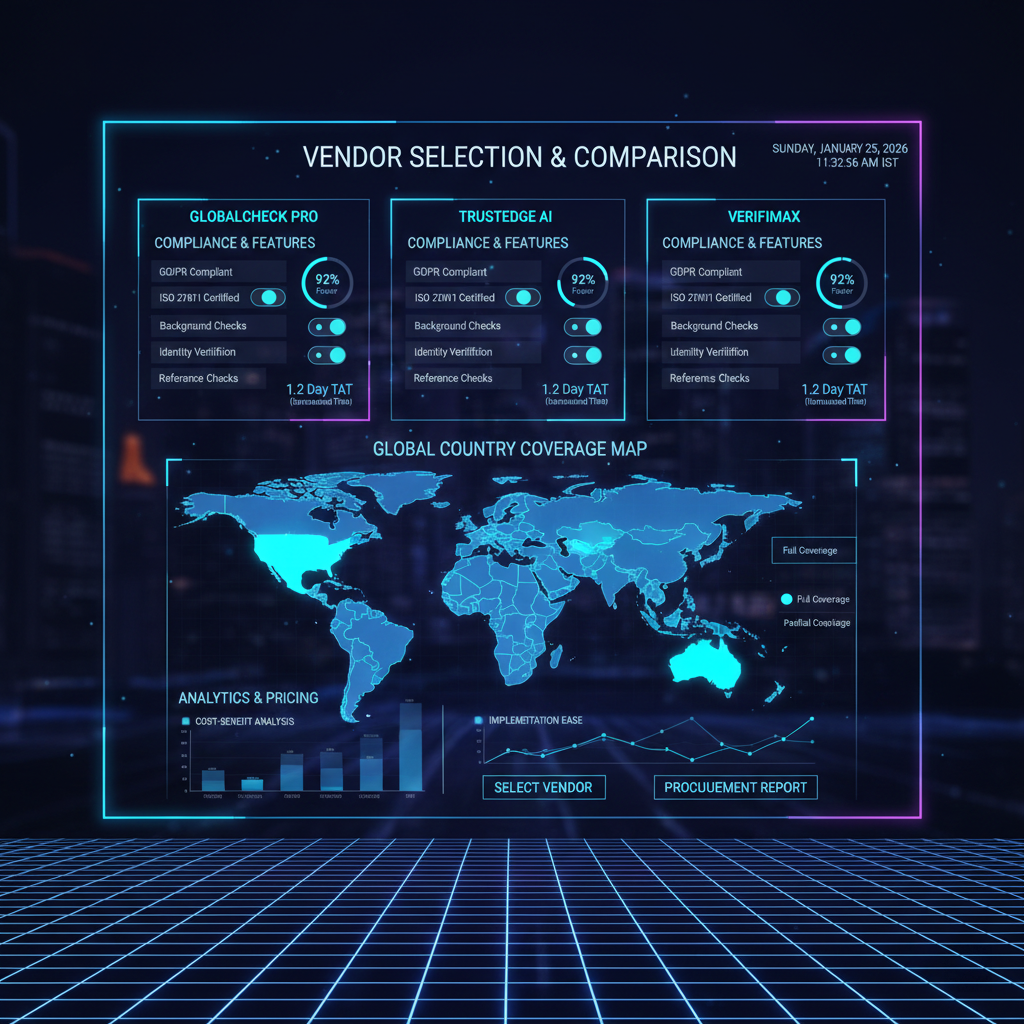
Evaluating background check vendors requires HR and compliance teams to assess capabilities across accuracy, turnaround time, regulatory compliance, data security, geographic coverage, integration, and candidate experience. Because screening vendors handle sensitive personal data, the procurement process involves deeper scrutiny compared to standard HR technology purchases.
Compliance is the first dimension. Vendors must align with legal frameworks such as FCRA for U.S. screening, GDPR for EU data processing, and ban-the-box regulations that govern timing and fairness. Vendors must also support dispute resolution procedures that allow candidates to contest inaccuracies, as mandated in several jurisdictions. Failure to comply exposes organizations to regulatory penalties and legal liability.
Speed is a major differentiator. Slow screening delays onboarding and risks candidate dropout. Vendors vary in data access methods—some rely heavily on manual verification, while others use digital integrations with educational institutions, government registries, or financial bodies. Platforms that provide real-time identity verification and automated document validation reduce turnaround and improve candidate satisfaction.
Global coverage is increasingly relevant as distributed and remote hiring grow. Vendors must provide localized screening workflows for education, employment, criminal, and identity verification across multiple countries. This requires knowledge of local privacy laws, data availability, and documentation practices. Regional disparities in record digitization can influence service-level agreements and turnaround expectations.
Integration capabilities influence operational efficiency. Screening platforms should connect with ATS, HRIS, and onboarding systems to automate initiation and status tracking. Reporting and audit documentation should be exportable for compliance audits and internal review. Vendors offering open APIs, SOC 2 compliance, and standardized connectors deliver stronger ecosystem compatibility.
Candidate experience is also important. Screening occurs at the end of the hiring funnel, where delays have the highest impact. Digitized consent, transparent communication, mobile-friendly workflows, and multilingual support reduce frustration and decrease reneges.
By using a structured vendor evaluation framework, organizations can select background screening solutions that support compliance, accelerate onboarding, and adapt to global workforce expansion.
