


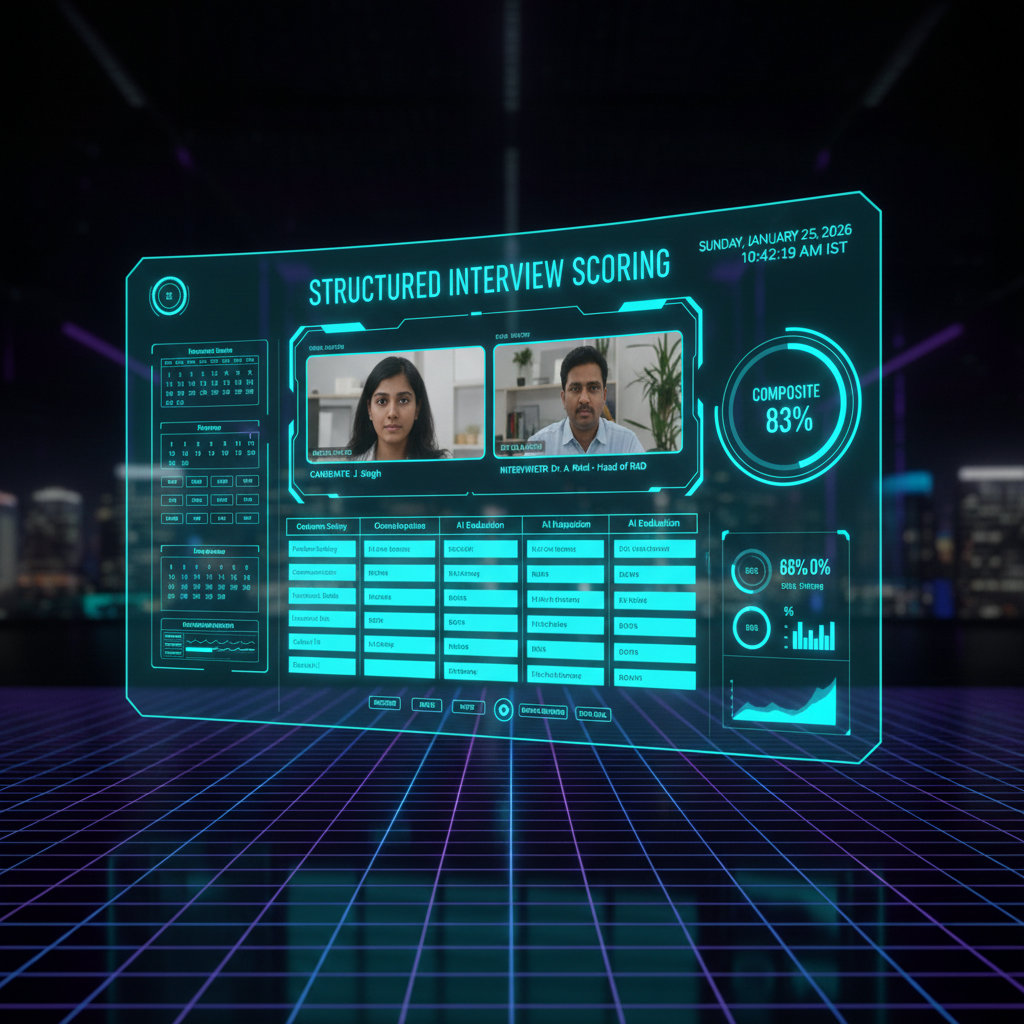
Structured interviewing has become the dominant best practice for improving hiring accuracy and reducing bias in talent evaluation. Instead of relying on unstructured conversational interviews, structured interviews use predefined question sets, competency-based evaluation criteria, and standardized scoring frameworks to compare candidates objectively. This shift has been driven by research linking structured interviewing to improved predictive validity and reduced variability in decision-making.
The structured approach begins with role analysis. Hiring teams identify the skills, competencies, and behavioral indicators associated with successful performance. These may include technical skills, communication, decision-making, leadership, or problem-solving capabilities depending on the role. Once competency areas are defined, interview questions are designed to elicit evidence through behavioral prompts or situational scenarios. For example, behavioral interviews ask candidates to describe past experiences (“Tell me about a time…”), while situational interviews present hypothetical scenarios requiring analytical response.
Evaluation criteria represent a core component. Instead of subjective impressions, interviewers assess responses using scoring rubrics that define what strong, average, or weak responses look like for each competency. This reduces interviewer bias and creates consistency across candidate evaluations. Calibration sessions allow hiring teams to align scoring standards and improve reliability.
From an operational standpoint, structured interviews enhance candidate fairness by minimizing informal variation across interviewers. They also support compliance initiatives, particularly in regulated environments where audit trails and documentation are critical. Interview notes, scores, and decision rationales can be stored in ATS or interview platforms for internal review.
Structured interviews do not eliminate human judgment but constrain it within a more reliable framework. They improve signal-to-noise ratio, reduce halo effects, and focus hiring decisions on performance indicators rather than subjective affinity or similarity bias. High-growth companies and enterprises adopting structured interviewing report improved correlation between hiring decisions and post-hire performance metrics.
Candidate perception also benefits. Structured interviews feel more professional and transparent, enhancing candidate confidence and engagement. When combined with prompt communication and efficient scheduling, structured interviews contribute to positive candidate experience and offer acceptance.
